Essay
Curatorial essay by Fran Gardner
NEVER THE SAME PATH, BUT ALWAYS THE SAME PLACE:
PAINTINGS BY GINNY SNOWDON
THE KEYS
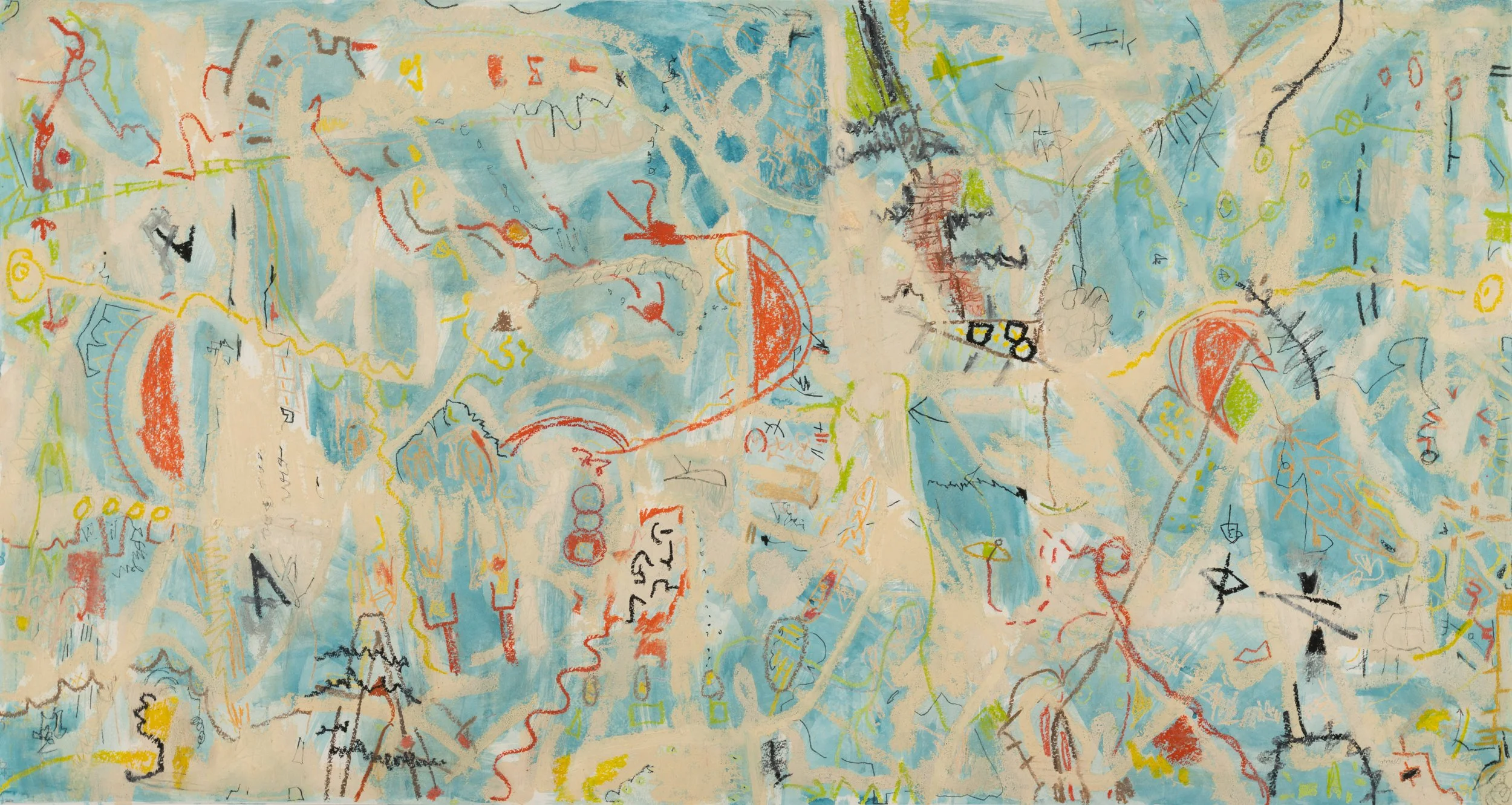
The key to understanding Ginny Snowdon’s work, for it is a puzzle to decode, is to not take any part of her surface for granted. There is no foreground of more importance than the background. There is no positive space or negative space. There is simply space, all of it containing meaning and message. This is her language, a way to see and communicate about life’s interconnectedness. If there is a figure, look carefully at the space in which it resides. If there is a suggestion of symbols, look closely. Are they related in some way? Snowdon said, “Life comes to me like a Lego-style jumble of chunks and pieces. These extraneous bits of life come deposited as raw material on the canvas. I strip away what is unnecessary to leave the bones, the bare story.”
This is not the polished, edited-for-the-evening-news kind of image. What Snowdon shows us is what is on the cutting room floor. The raw, inelegant day-to-day parts that our lives are made of as we strive to show the world our curated selves. “Allowing for imperfection reveals embedded, unrefined beauty. Getting it down to where it all began is where the common denominator is found. We are more alike than not,” said Snowdon.
While Snowdon’s work over the years tends to sort itself into themes – figurative; interest in language, maps and symbols; and highly abstract work with elements of each of these – her work without question is her own. She has developed a distinct marking system that is, without fail, present in every piece. Many of the figurative pieces devote the space to the atmosphere, the figures occupying a relatively small area, allowing the negative space to come forward and have as much weight and importance as the figures. Like Cezanne’s Boy in a Red Waistcoat (1888-90), where the boy’s pants and the background drape are indistinguishable from each other, pulling both to the forefront space, Snowdon’s marking system, ever present as a surface embellishment, likewise pulls her spaces forward while continuing to distinguish clear foreground and background areas.
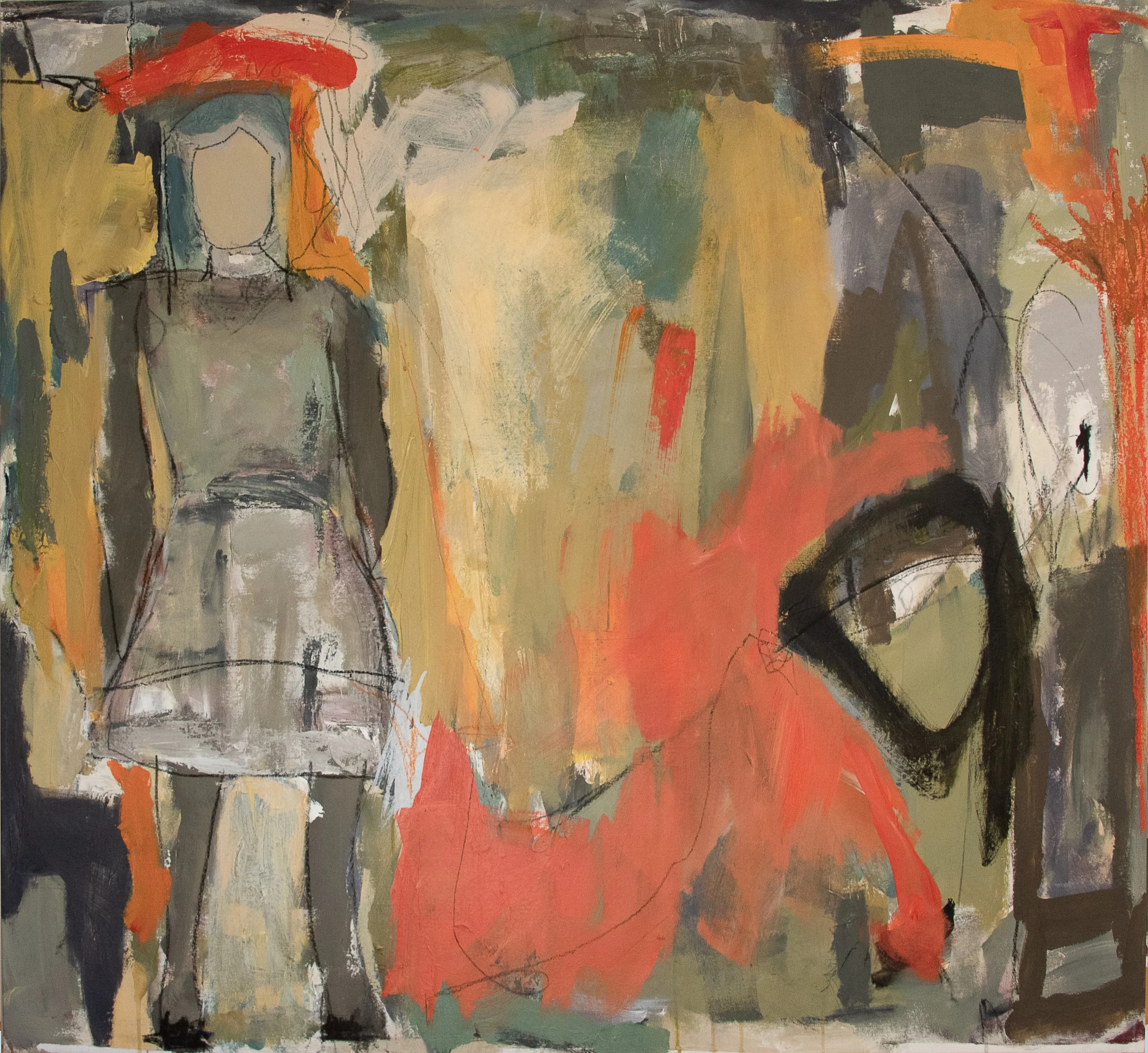
In Snowdon’s piece, The Hero’s Journey, the primary figure emerges from a like background. Her body is of her surroundings – camouflaged, in a sense. She wears a dress, has long hair, and a very slight suggestion of breasts. Her clothing is less a dress and more a uniform, the undergarment that a knight might wear beneath chainmail. On her head a coif, head protection worn beneath a helmet. This woman is preparing for a challenge, gathering herself and her tools in a moment between the comfort of home and some form of confrontation. Her future, perhaps? She is readying herself, her shield, her protection, nearby, as suggested by the heavy black triangular shape on the opposite side of the canvas.
This integration of the figure within her surroundings suggests she is at one, indeed, a part of, not apart from, her world. Snowdon’s marks, ever present on the surface, draw a clear line from the figure to the shield, then from the shield swooping across the upper portion back to the figure, encompassing; a clear signal to connect the figure with the shield-like shape. This person is going towards an unclear future, leaving a space that she is literally a part of, comforting and familiar.
Snowdon’s unrefined marks may seem erratic, but upon close examination they create a pathway for the eye to travel, collecting the points of interest within the painting, while simultaneously exploding off the surface with raw energy. Like the best Jackson Pollock paintings, the viewer can experience Snowdon’s energy quaking at the surface.
TRANSLATION
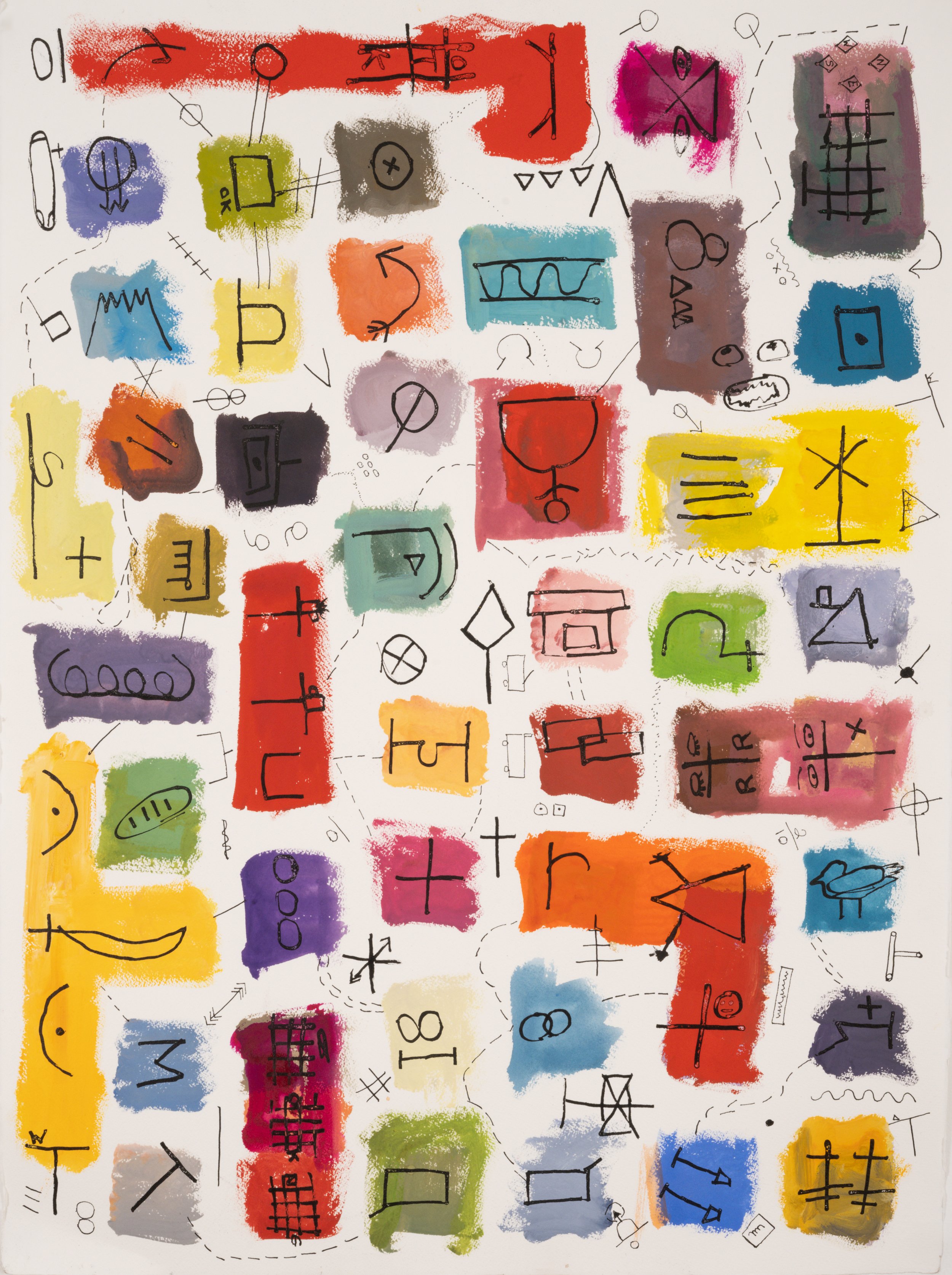
Around 2012, Snowdon began an exploration of personal symbol development, starting with the ‘hobo code,’ and quickly moving to her own unique marking system. The term ‘hobo’ refers to the itinerant worker who moved from place to place, often seeking employment. According to Colin Marshall, in his article The Hobo Code: An Introduction to the Hieroglyphic Language of Early 1900s Train Hoppers, “Living such a lifestyle on the margins of society demanded the mastery of certain techniques as well as a body of secret knowledge, an aspect of the heyday of hobodom symbolized in the ‘hobo code,’ a special hieroglyphic language.” The language emerged out of necessity (as does all language) as a sort of basic survival guide denoting safe zones, danger, navigation, and food. While Snowdon is clearly influenced by her study of ‘hobo code,’ as demonstrated in the 2012 painting, Personal Symbols, her marks soon gave way to interpretation, as seen in the subsequent painting of the same year titled Personal Alphabet Sampler. It is in this painting that Snowdon introduced energetic curves and squiggles as she discovered her unique system of marks, her own language, which appears in nearly every painting after that, sometimes as a surface element and sometimes embedded in the atmosphere.
Snowdon’s interest in the ‘hobo code,’ a viable and useful language important to itinerant people of a certain era and of little interest to anyone outside of that culture, echoes Snowdon’s interest in the raw information that is hidden, obscure and unexamined. The fact that she adapted this language into a mark-making system of her own is another example of her efforts to bring understanding, creating a bridge through which to describe and connect the mundane moments of our lives.
LIFTING THE FOG
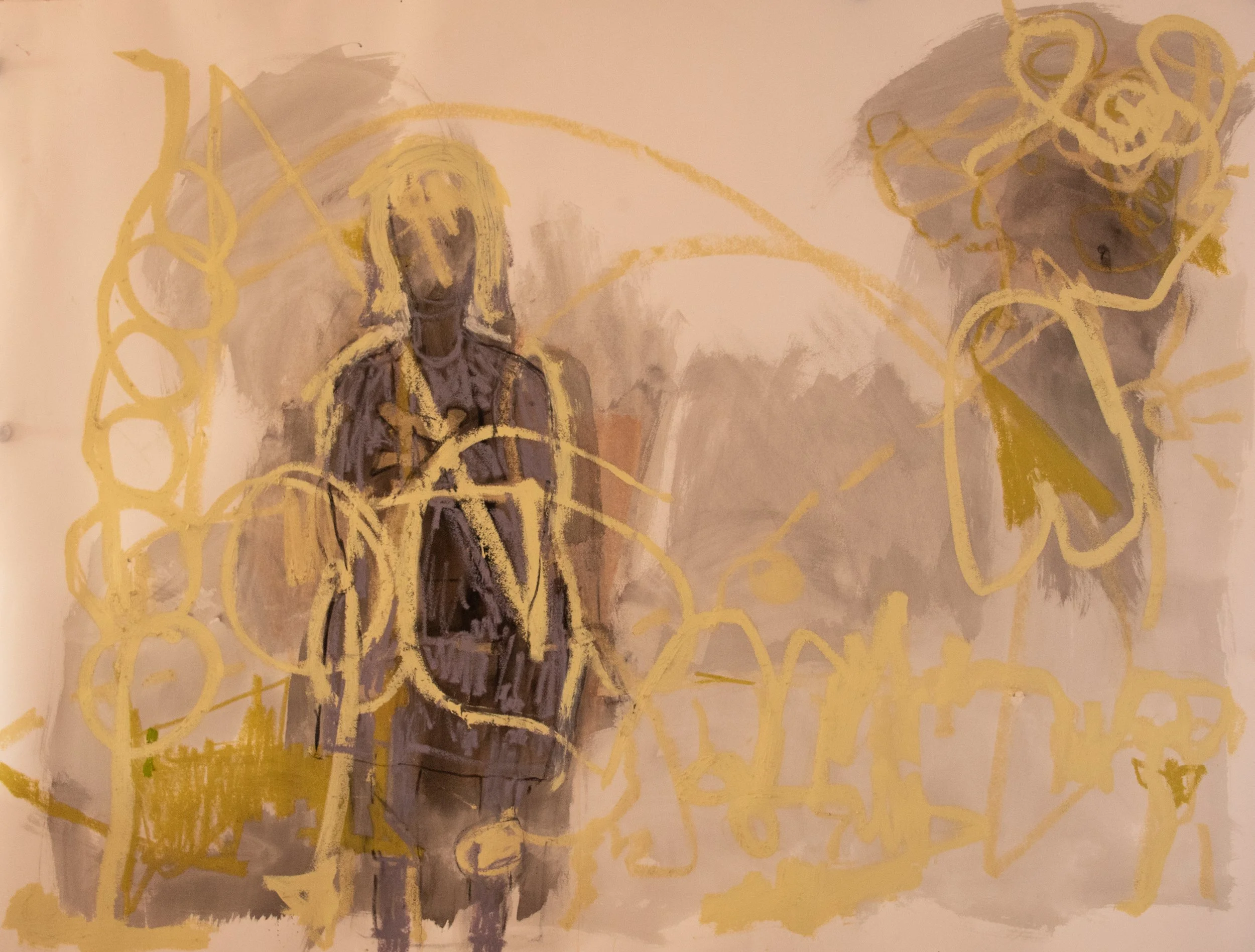
Snowdon’s work is a suggestion of our human commonalities. We share so many experiences of everyday life that when assimilated, they create a shared human mythology. She puts her faith in the viewer to find something they will connect with in the piece, and by extension, with her. In the piece, The Fog Lifts (2018), a lone figure, dressed in black, is behind a barrier. If hair and clothes are an indication, this is a female, though gender is of no relevancy here. This is a human experience, not a gendered one. The barrier is not a wall but swooping and curving lines that intersect, making a sort of open fence. These lines don’t enclose her, rather, they create a filigree, an almost decorative space, inside which she resides. The atmosphere is airy, light. In the upper right quadrant, a cluster of looping lines and squiggles rest against a gray amorphous shape suggesting a presence. She is balanced by this specter; it is of her same essence. She is the form that has emerged from this formlessness. Her world is unrefined but in the making, watched over by a playful, unnamed entity. Who among us hasn’t wished for a fairy godmother, a helpful sprite, a guardian angel while we deal with our everyday lives, our chores, our profound happinesses and sadnesses? Snowdon’s piece lifts the fog to show us that we are not alone.
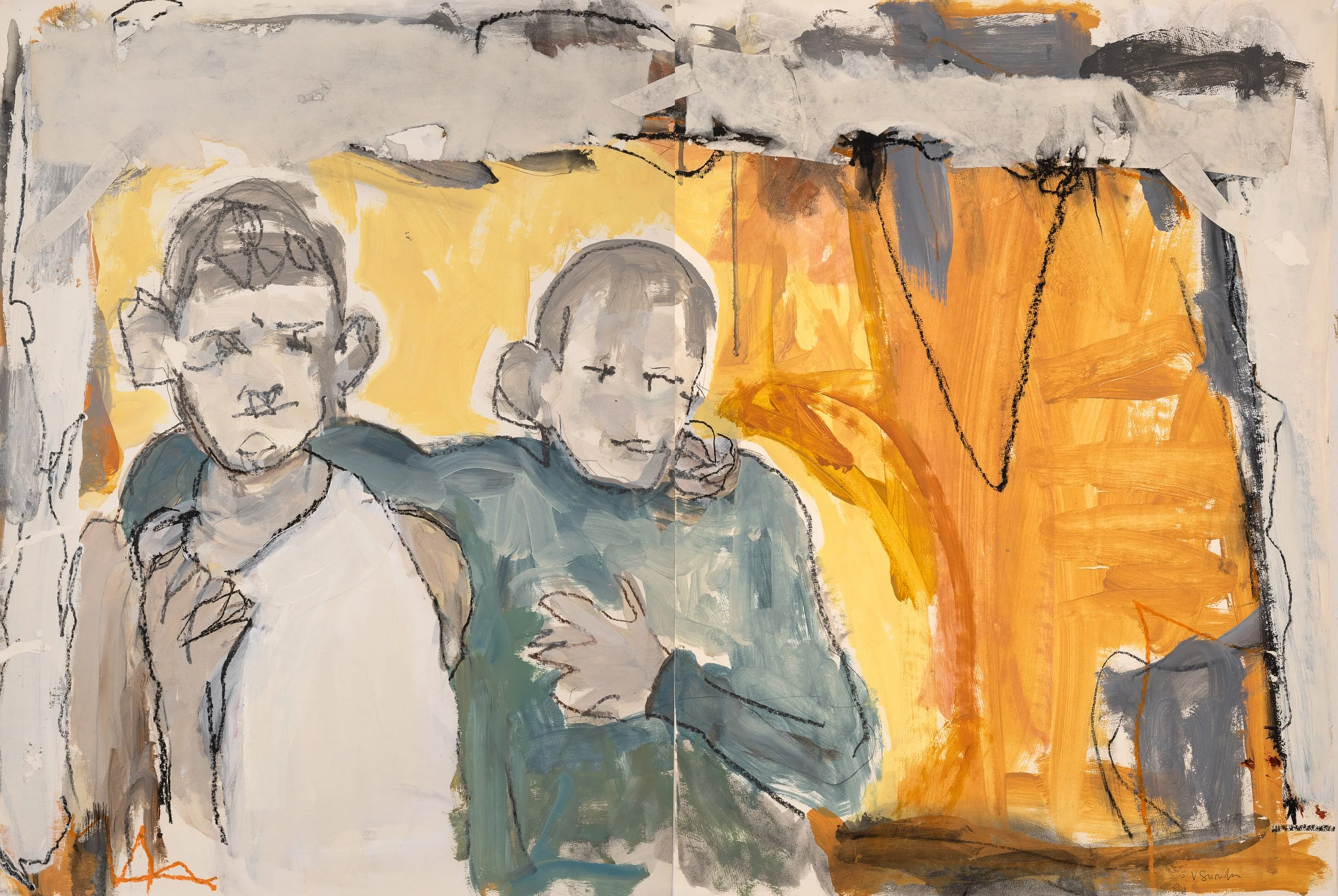
Evidence of Snowdon’s interest in the human experience is found in many of her paintings, both figurative and non-figurative. In a very literal piece titled Inseparable, two boys, arms casually draped around each other, face the viewer, at ease. Indistinct faces along with carefree body language reflects the intimate relationship of friendship – boys, perfectly comfortable together, unafraid to demonstrate their platonic affection. The kind of friendship that, if you are lucky, you have experienced in your life.
In the painting Did You Bring the Breadcrumbs? Snowdon effectively uses her personal symbolic language to present something akin to a scribbled map on a napkin, clearly imparting the feeling of being lost, the aimless wandering and confusion, and ultimately the blame. The eye meanders, takes awkward twists, turns, and switchbacks that always manage to loop back to the starting point. Never the same path, but always the same place. Implied in the title is the accusation that the other is responsible for knowing the way, or leaving the trail in which to find the way. We’ve all experienced this co-dependency. The unspoken assumption that the companion is in charge and should have known to bring the necessary tools for any and all unforeseen problems.
If Snowdon’s work is a puzzle, what a pure delight it is to attempt to solve it. To move the pieces around until something clicks, to ponder the relationship between the disparate elements and create theories of meaning and message. In her words, “These are the everyday bits of life, the unassuming, the unremarkable. In actual fact, this is how we spend our hours, our days, our lives. I capture these moments, give them their due, honor and elevate them, frame them, and then hand them back in the form of a painting so that others can notice and see them too.” If, at the end of the exercise you find her work touches an emotion, evokes an unexpected reaction, surprises you with the discovery, well then, she’s done her job.
Fran Gardner is an artist, author, and professor emeritus of art and art history based in South Carolina. Ginny first met Fran in 2018 when Fran was leading a retreat at the Atlantic Centre for the Arts in Florida, and the two have worked together ever since.